Family-friendly beaches in and around Vilamoura
Updated September 5, 2026 · 6 min read
The two questions that actually matter on a beach appear in no brochure: how deep does the water get after three steps, and how does the pushchair reach the sand. Around a dozen beaches lie between Quarteira and Quinta do Lago, and they differ far more in those two respects than in their sand. What Vilamoura with a baby sorts out roughly is set out here in detail.
Praia de Vilamoura – the beach with no drive
The main beach, also called Praia da Marina, begins immediately next to the harbour basin. Rock structures reach into the water at both ends, so it lies calmer than the open stretches further out; the sand is wide and level, the entry shallow. Showers, toilets, sunbed hire, places to eat on the sand and water sports hire are all there. The Câmara Municipal de Loulé lists it among the beaches with provisions for people with reduced mobility – have that confirmed locally.
Parking is free behind the McDonald’s, five minutes on foot; the closer areas charge and fill early in summer. It gets busy precisely at the marina end. Five to ten minutes east towards Quarteira it thins out noticeably, and that is where towels still lie apart in August.
Rocha Baixinha: a boardwalk instead of steps
Praia da Rocha Baixinha forms the eastern end of Praia da Falésia right beside the marina and belongs administratively to Albufeira. A boardwalk leads from the car park onto the sand, with no steps. In this corner it is the only step-free access, and the reason it works with a pushchair. The beach is over 100 metres wide, the entry gradual, with toilets, showers, sunbeds and a beach bar. Parking at the Vilamoura end costs €2.80 an hour; in town it is free. On foot from the marina across the wooden bridge, 15 to 20 minutes.
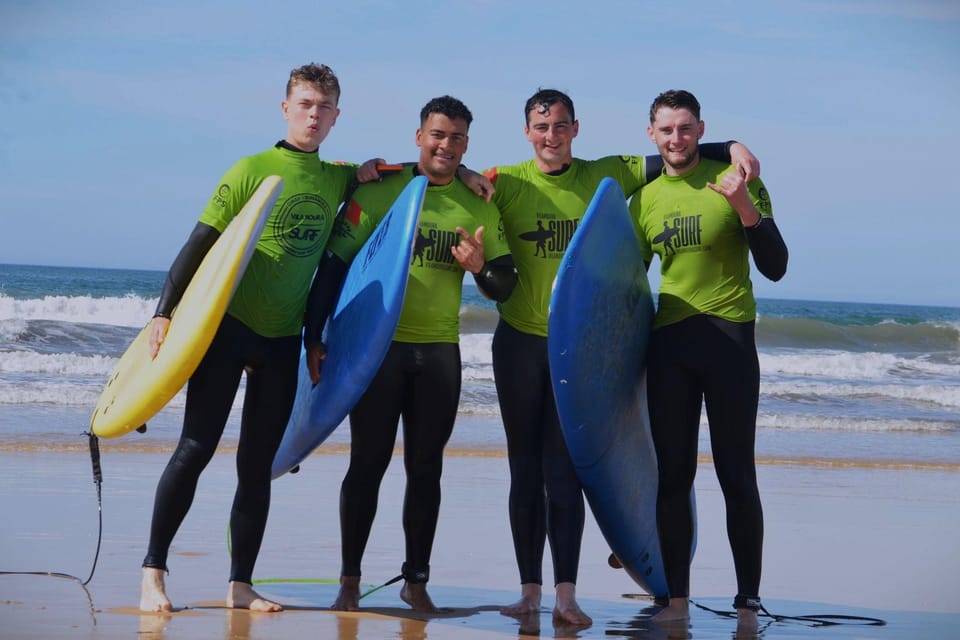
The catch is the Nascente section: distinctly more open to the Atlantic than the marina beach, the swell bigger, and surf schools teach there. With small children you notice the difference only in the water.
Praia da Falésia lies to the west
This direction is regularly got wrong, so to be clear: Praia da Falésia runs about 6 km from Olhos de Água in the west to Vilamoura in the east. From Vilamoura you drive west; Olhos de Água is around 10 km away, roughly a quarter of an hour by car.
Three main access points, and they are very different. At Olhos de Água you step onto the beach at village level, no cliff descent, but only 43 parking spaces down by the water. At Açoteias a concrete staircase leads down from the clifftop car park, around 80 steps; a sunbed and parasol cost €12 a day. At the end nearest Vilamoura, by the Pine Cliffs, a boardwalk with about 60 steps drops to the sand.
What the photograph does not tell you: eighty steps with a cool bag and a child on your arm is a real undertaking, and the way back up at five is the harder half. The pushchair stays at the top or gets carried. With a toddler, take the eastern end for the cliff beach – the cliffs get lower and the water stays shallow longer, whereas it drops away faster towards Albufeira. In August the clifftop car parks fill early; on the sand, ten minutes’ walk from the access point is usually enough. More on this under Vilamoura with a toddler.
Quarteira: level access, but not shallow water
Quarteira lies around 3 km east, about five minutes by car, and is walkable along the water. Groynes damp the waves, the access from the Avenida Infante de Sagres, known locally as the “Marginal”, is level and served by ramps, plus showers and toilets. The point that rarely comes with it: the water here gets deeper fairly abruptly. Calm is not the same as shallow, and with a four-year-old that is the difference that counts.
The lagoon at Praia do Almargem
East of Quarteira, still in the Concelho de Loulé, a shallow lagoon collects behind a sandbar at the mouth of the Ribeira do Almargem: the Lagoa da Foz da Ribeira do Almargem. Small children wade in it without a wave knocking them over, and it turns up on hardly any beach list. Behind it, low ochre cliffs with pines on top, dunes, little activity. The price: the last stretch of access road is an unsurfaced track and you park on gravel. Sunbeds, parasols and lifeguards are seasonal.
Vale do Lobo and Quinta do Lago
Vale do Lobo is about 13.6 km away, a good 20 minutes by car. Red cliffs, access via the resort’s Praça, no natural shade. A sunbed and parasol are quoted there at up to €45 a day – the most expensive beach day in the area.
Quinta do Lago is 16 to 17 km away, roughly 20 to 25 minutes via Almancil. The access is a 319-metre boardwalk over the Ria Formosa, step-free and, for most children, the real attraction. The beach runs about 3.5 km, between Praia do Ancão in the west and Praia de Faro in the east. Count the boardwalk twice: once out, once back with a tired child.
Lifeguards, the Blue Flag, and what neither of them means
The bathing season is an administrative matter and differs by municipality. In the Concelho de Loulé, meaning Vilamoura, Quarteira, Almargem, Vale do Lobo, Ancão and Quinta do Lago, it runs from 1 June to 30 September. Albufeira has the longest in the Algarve, from 15 May to 15 October, and that covers Praia da Falésia and the Rocha Baixinha sections. In April or late October: empty beaches, no supervision.
On the Blue Flag: in 2026 every one of the ten coastal beaches in the Concelho de Loulé flies it, along with the Marina de Vilamoura. The Albufeira list for 2025 included Falésia/Açoteias, Falésia/Alfamar and the three Rocha Baixinha sections, among others.
What does not follow: that a beach is safe. The award rates water quality, facilities and organisation, not the conditions on the day you visit. Currents, swell and channels in the sand change with tides and weather, and a shallow entry in the morning can be a different thing by afternoon. The only current information is the flag at the post and what the lifeguards tell you.
Shade is scarce, wind is reliable
None of these beaches has any natural shade worth mentioning. Under the cliffs a strip lies against the wall in the morning, and by the afternoon it has gone.
For wind, the regional pattern holds: in summer the nortada builds through the afternoon, a north-westerly sea breeze that makes the heat bearable. The south coast lies more sheltered than the west coast, it is noticeable all the same, and open stretches with dunes behind them catch more of it than the bay between the rocks by the marina. The counterpart is the levante from the east or south-east: hot, dry air and no cooling sea breeze.
For many children the swim stop is the best part
Several trips from the marina stop along the way for a swim, and that is what children remember. A sailing schooner runs three hours to caves and a swim stop for €29.40 (434 reviews). Five hours to Benagil Cave with a swim and brunch on board costs €49 (618 reviews) – cheap for the length, but five hours with no way off is long. Overviews at the sailing trips and the Benagil cave tours from Vilamoura; what is possible on land is under things to do.
None of that replaces an age limit. Operators set different limits; they appear on the individual booking page and should be read there before booking. How to check is in Boat trips with kids.