The Algarve Golden Triangle: what links Vilamoura, Vale do Lobo and Quinta do Lago
Updated October 14, 2026 · 8 min read

“Golden Triangle” appears on no road sign. The term comes out of the property trade and describes something the map does not show: a short stretch of coast where holiday resorts, golf courses and villa estates sit so close together that they work like a single place without being one. Spend a week here and you will shuttle between Vilamoura, Vale do Lobo, Quinta do Lago and Almancil.
Where the triangle starts and stops
Two readings are in circulation. The narrower one draws the triangle between Almancil, Vale do Lobo and Quinta do Lago; the wider one makes Vilamoura the western corner and puts Almancil in the middle. There is no binding boundary, because it is not an administrative unit.
Something else can be stated precisely. All of it lies in the Loulé municipality, whose coastline measures only about 13.5 kilometres in total. From west to east it runs Vilamoura, Quarteira, Forte Novo, Almargem, Loulé Velho, Vale do Lobo, Garrão Poente, Garrão Nascente, Ancão and Praia da Quinta do Lago. Almancil is the only one of the names that is not on the water; it sits inland on the N125, halfway between Loulé and Faro. Vale do Lobo lies roughly 6.5 km south-east of it, Quinta do Lago about five kilometres south, and Faro airport around 15 km to the east. The two outer corners, Vilamoura and Quinta do Lago, are about twenty minutes apart by car: near enough for a single day, too far to walk.
Why this differs from the rest of the coast
None of these places grew organically. The land for Vale do Lobo was bought in 1962 and the resort opened in 1968. Quinta do Lago was laid out from 1971 on the 550-hectare Quinta dos Ramalhos, a stone pine forest with a ruined farmhouse that became the Casa Velha restaurant. Within a few years it had an artificial lake, a bridge to the beach and 27 holes of golf.
That is why the area lacks what other coastal towns are known for: no strip of bars, no wall of high-rises along the sand, no promenade you simply walk down in the evening to see what is going on. The centre of Vale do Lobo is the Praça, a square of restaurants and shops above the beach that belongs to the resort. For activity you go two kilometres further to Quarteira, densely built and busy all year.
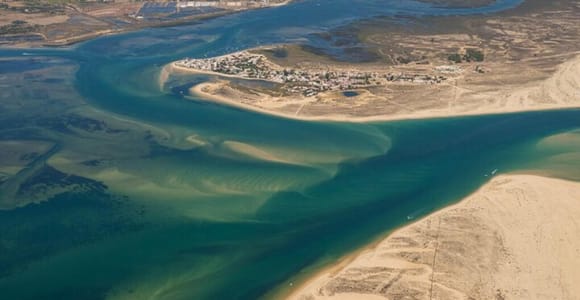
There is also a line that explains the difference better than any price list: this is where the cliff coast ends. To the west the sandstone cliffs with their coves and sea caves run all the way to Cabo de São Vicente; to the east the Ancão peninsula begins the first sand spit of the Ria Formosa, which means flat ground, dunes and lagoon. The triangle sits on the changeover.
Almancil: the point where everything crosses
Almancil is the least glamorous corner of the triangle and the most useful one. Around ten thousand people live here, and it has the supermarkets, banks, doctors, garages and the access roads to both big resorts.
Worth seeing is the Igreja Matriz de São Lourenço on the edge of town. Walls and cupola are entirely lined with blue and white azulejos, made in 1730 to designs by Policarpo de Oliveira Bernardes and telling the legend of Saint Lawrence. The 1755 earthquake, which destroyed almost everything in the Algarve, left the church all but undamaged. The visit takes half an hour and is the densest piece of art in the area.
The town itself is not a place for strolling: the N125 runs straight through it, and there is nothing old between the roundabouts. What Almancil does have is most of what can be booked on land. Karting Almancil Family Park, with a 760-metre main circuit, costs €14 and is one of the cheapest offers in the region (556 reviews, 4.4 stars). At the other end sits a guided buggy tour from Almancil at €125, an hour and a half to three hours long and, with 1,126 reviews at 4.8 stars, the most reviewed land offer after Zoomarine and the Loulé salt mine at €25. More of them under things to do on land.
The beaches: from cliff into lagoon
All ten beaches along this stretch hold the Blue Flag and are still very different from one another. Praia de Vale do Lobo lies below the Praça, sandstone cliffs behind it and the shortest walk in. Further east the cliffs turn into dunes: Garrão Poente and Garrão Nascente behind wooden walkways, with Dunas Douradas beyond.
Praia do Ancão runs for about a kilometre and a half and is reached over the Passadiços do Loulé Litoral, which continue east and west. Two fish restaurants stand directly above the dunes. No bus goes there; without a car or a taxi you can only arrive along the sand or the walkways.
The most unusual approach belongs to Praia da Quinta do Lago: a wooden bridge some 300 metres long over the channels of the Ria Formosa, the only way onto the sand, with mudbanks, salt marsh and birds to either side. At low water there is mud rather than water beneath the bridge, which disappoints some visitors and fascinates others. The car parks at the walkways are paid and fill early in August.
The big sandy beach of the triangle is at its western end and belongs to Vilamoura; what Praia da Falésia and its orange cliffs are about is covered in what to see in Vilamoura.
Ria Formosa: the eastern third
The Ria Formosa is a natural park of sand spits, channels and salt marsh that stretches 60 kilometres from the Ancão peninsula to Manta Rota and covers roughly 18,400 hectares, of which about 11,000 hectares are lagoon averaging only two metres deep. Its western beginning is here in the triangle, not somewhere out east.
On foot, three trails open it up and run into one another. The São Lourenço trail follows a good three kilometres between the San Lorenzo golf course and the wetlands, the Caminho do Ludo carries on through the old salt pans, and a coastal walkway links Praia do Ancão with Praia da Quinta do Lago. At the Lagoa de São Lourenço there is a bird hide; the purple swamphen can be seen closer here than almost anywhere else in the Algarve, and flamingos, spoonbills and black-winged stilts stand over the salt pans.
The well-known boat trips out to the Ria Formosa islands do not start in the triangle but further east at Olhão and Faro. The three-hour trip to the islands of Armona and Culatra costs €35 (605 reviews, 4.7 stars), but you have to drive there first. From the triangle the lagoon is a matter of bicycles and boots; guided bike tours begin in Quinta do Lago itself.
Golf, and what is genuinely special about it
Density is the point. Vale do Lobo has two courses, the Royal and the Ocean, the latter designed by Sir Henry Cotton. The famous one is the 16th on the Royal, a par 3 whose tee shot carries a run of cut-away cliffs and which is reckoned one of the most photographed holes in Europe. The Portuguese Open was played here in 2002 and 2003.
Quinta do Lago holds three courses: the South, the North rebuilt in 2014 with Paul McGinley involved, and the Laranjal, opened in 2009 in the Ludo valley on a former orange grove. Between 1976 and 2001 the Portuguese Open was staged here eight times. Add San Lorenzo on the edge of the Ria Formosa and Pinheiros Altos with its 27 holes. Green fees, though, cannot be booked through the platforms this site compares; if you want to play, you book with the course directly or through your accommodation.
What the area costs
It is expensive, but not evenly so. Across the 73 offers running from Vilamoura the median price is €57 and the cheapest is €6. The buggy tour from Almancil, at €125, costs more than twice the median, while the karting park at €14 and the guided wine estate visit with tasting in Loulé at €18 show that a cheap day is possible. There is no ceiling at the top end: a private boat starts at €585, and the median for a private yacht charter is €1,040.
Eating and sleeping are where the level climbs hardest. In Quinta do Lago, Gusto by Heinz Beck at the Conrad Algarve holds a star in the 2026 Michelin guide, and the beach restaurants on the Ria Formosa are priced to match. If you want to be in the triangle without paying its prices, you stay in Almancil or Quarteira.
Getting between the corners
There is no continuous coast road. Every drive between Vale do Lobo, Quinta do Lago and Vilamoura goes inland, usually via Almancil and the N125. From Quinta do Lago it is about fifteen minutes to Vilamoura and Quarteira, and around five to Vale do Lobo.
Public transport covers only part of this. Vamus line 85 links Loulé to Vale do Lobo via Almancil, on weekdays and with a handful of departures a day; from Almancil the ride takes just under a quarter of an hour. In July and August Vale do Lobo runs an internal shuttle for guests holding the relevant pass. In practice that means a hire car or a taxi, or the week gets tight. From Faro airport to Vilamoura or Quarteira there is a private transfer from €35.
Who this is the wrong area for
Anyone who wants to head out in the evening without planning first is in the wrong place. So is anyone looking for an old town; Loulé, Faro and Tavira deliver that, the triangle does not. Without a car you spend a lot of money on taxis. And anyone coming for the sea caves has landed at the wrong end of the coast: they lie to the west, and from Vilamoura it is about an hour and a half on the water to Benagil Cave.
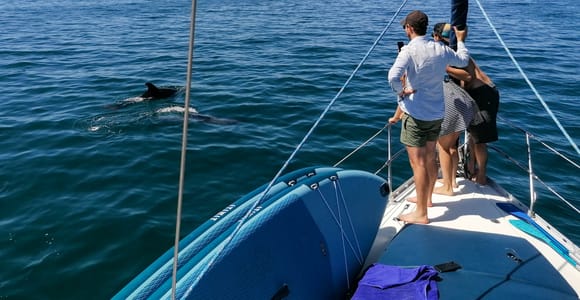
The area is right when space is the reason for coming: golf in the winter half of the year, beaches where people spread out, trails through the lagoon, a hire car outside the door. For families it is the level walkways and the beaches with summer lifeguards that count, covered in more detail in the overview for families and in the articles on Vilamoura with a baby and with a toddler. From the water, the western corner offers the most: four dolphin watching trips from €35, eight sailing trips from €29.40 and five sunset cruises from €25. Whether children are allowed on a particular boat is for each operator to decide; how to check that beforehand is set out in the article on boat trips with kids.