Loulé market: which day, which hall, and what €34 is really for
Updated September 16, 2026 · 7 min read
Almost everything written about Loulé market treats it as one thing. It is three, they happen on different days, and the difference decides whether your morning there is memorable or merely pleasant.
Loulé sits inland from Vilamoura, past Almancil, and its market building is the town’s landmark. The question is not whether to go. It is which day you go and whether you pay for a seat on a bus.
Three markets, and only one of them is daily
The tourism brochure published by Loulé council sets the three out clearly.
The Mercado Municipal, the covered hall itself, runs Monday to Saturday all year round, from 7 am to 3 pm. Fish, fruit, vegetables, cheeses, cured meats and a run of handicraft stalls.
The Mercado Produtor, the producers’ market, takes place every Saturday morning in the streets surrounding the hall, from 7 am to 1.30 pm, with growers from across the municipality selling what they have picked.
The Mercado Semanal, the weekly open-air market, also runs on Saturday mornings — clothing, footwear, costume jewellery, assorted handicrafts, towels and household goods, at prices the brochure describes as more accessible, and with haggling expected. This is the market most listings refer to as the Roma market.
So a Tuesday in Loulé gives you the building, the fish counter and a quiet town. A Saturday gives you all three at once, plus the crowd that comes with them. If you have one morning, make it Saturday. If crowds are the thing you came to the Algarve to escape, go on a Wednesday and accept that you are visiting a market hall rather than a market day.
The building is the reason to go even on a quiet day
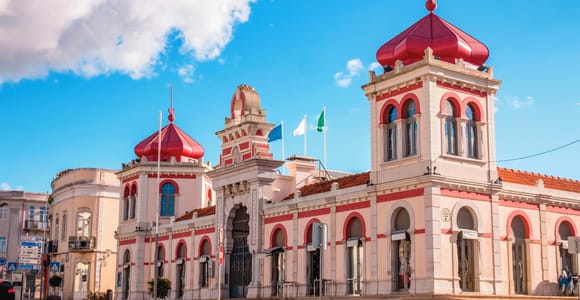
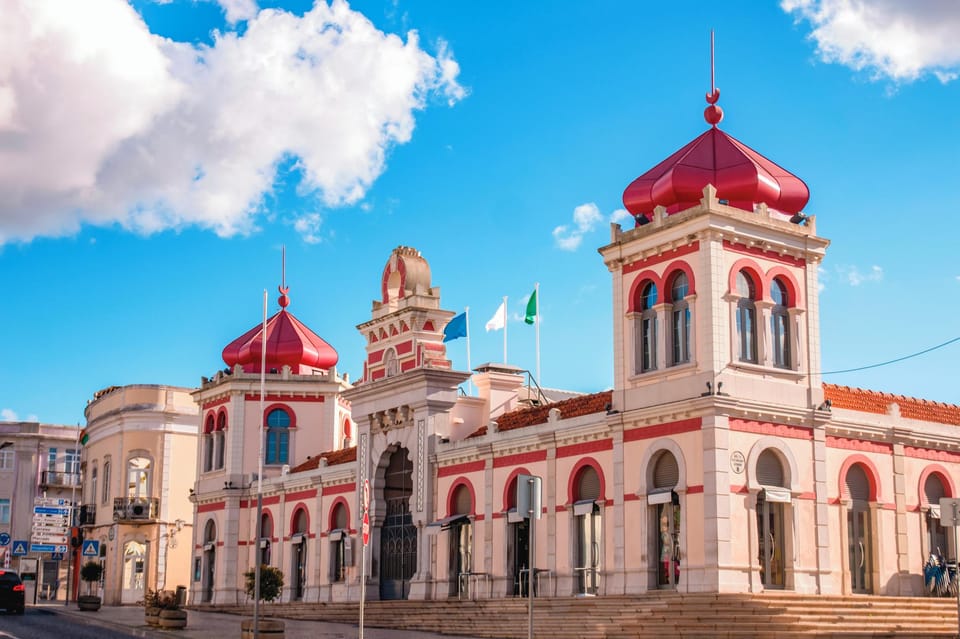
The council’s own history dates the market’s opening to 27 June 1908, to a design by the Lisbon architect Alfredo Costa Campos, itself a reworking of a 1903 project that drew on an earlier one from 1898. It was built in a revivalist style of Arab inspiration, with four pavilions and four gateways, and the scale was meant to signal the prosperity of the municipality.
Two of the corner towers that appear in the 1905 drawings were cut for cost and only built during the restoration that began in 2004; the market reopened on 1 February 2007. The council records that the building was awarded a tourism prize in 2008, a century after it opened.
That is more history than most Algarve buildings can offer, and it is the part a bus tour will not slow down for. Fifteen minutes spent looking at the four gateways and the tilework is fifteen minutes better spent than a third lap of the clothing stalls.
What the organised trip adds — and what it costs
The Loulé Market day trip is listed at €34 per person for four hours, with 4.3 stars from 18 reviews. Included: hotel pick-up and drop-off, a guide, and food and drinks. The bus is described as spacious, comfortable and air-conditioned, and the listing says pick-up is from selected areas along the Algarve coast.
The description promises time at the covered market — which it calls the largest covered market in southern Portugal and a hive of activity since 1908 — plus the Roma market on the edge of town and free time for the castle and its archaeological museum. The rating breakdown is worth reading: guide 4.8, transportation 4.8, value for money 4.5. Travellers rate the ride higher than the price.
Two practical points sit in the conditions. First, meeting points are arranged as close as possible to each hotel, and the operator needs the address of where you are staying — so book with your accommodation details to hand, and expect a short walk rather than a doorstep collection. Second, the listing states plainly that the trip is not suitable for wheelchair users. If that applies to anyone in your party, our wheelchair article and the notes on reduced mobility are the place to start instead.
A second option, a half-day local tour ending at Loulé market, is listed at €49 for four hours and adds Praia da Falésia, a birdwatching observatory and the viewpoint at Cerro de Almancil before the market. Read its terms carefully: its free pick-up and drop-off is stated for Albufeira, not Vilamoura.
Ask which weekday you are being sold
This is the single thing to check before paying, and no listing states it on the page: which days the departure actually runs.
A four-hour trip that leaves on a Saturday delivers all three markets. The same trip on another weekday delivers the hall and the town. The booking calendar answers it — open the available dates before you choose an option, and if only one weekday is offered, that is your answer about what you will see.
Going under your own steam
Entry to all three markets is free. If you have a car, the trip costs fuel and parking, and you choose your own hour — arriving at 8 am on a Saturday is a different market from arriving at 11, because the producers’ market closes at 1.30 pm and the best of it goes early.
The €34 therefore buys transport, a guide and the absence of a parking problem on the busiest morning of the week in a small inland town. That is a fair trade for some people and an obvious waste for others. Without a car it is close to the only practical way; our article on getting around without a car explains why.
Loulé rewards a second stop while you are there. The rock-salt mine lies on the same side of town and, with 1,727 reviews, is the most-reviewed guided visit anywhere in this catalogue, and the Quinta da Tôr winery runs tastings nearby. Both are bookable separately, and combining one of them with a Saturday morning at the market makes the inland trip worth the drive. For the wider picture of what lies beyond the marina, see what to see in the Golden Triangle and the full list of things to do around Vilamoura.