The drive worth taking from Vilamoura: Querença, Salir, Rocha da Pena and Alte
Updated October 14, 2026 · 8 min read

If a hire car earns its keep in Vilamoura on one day, this is the day. Not because the inland Algarve is a secret — it is signposted, it is in the tourist board’s own material — but because it is the one part of this area that the selection simply does not reach.
We checked. Of the 59 offers listed on this site, not one visits Querença, Salir, Rocha da Pena or Alte. There are jeep safaris that pass through villages of that kind, and there is a day trip to Silves and Monchique, but the four places below are not on anybody’s itinerary from this marina. The bus does go: from the Quarteira terminal via Loulé to the Fonte Pequena stop at Alte takes around two hours and twenty minutes, with a change. By car it is about 35 kilometres.
About 35 kilometres of road against two hours and twenty minutes on a bus with a change in it: that is the entire case for the rental car, stated in one line.
The shape of the day
Head inland past Loulé and take the villages in a loop rather than a line: Querença first, then Salir, then Rocha da Pena, then Alte, and back down to the coast. The distances between them are small — Alte to Salir is under 14 kilometres by road — but the roads are narrow, hedged with dry-stone walls and carob trees, and the clock runs on bends rather than kilometres. Do not plan the day off a map measurement. Budget the whole day if you want to walk, half a day if you do not.
Do not do it on your arrival day. Do not do it on the day you fly home. And if you are going to be inland only once and you want the market, make it a Saturday and read the Loulé market article first, because the market that makes Loulé famous runs on Saturday mornings only.
Querença: the small one
A typical Algarve village of whitewashed houses and traditional architecture, is how the national tourist board describes it, and there is not much more to it than that — which is the point. The church of Our Lady of the Assumption on the square dates from the sixteenth century. Nearby lies Fonte Benémola, a protected natural area and a birdwatching site. Local crafts run to basketry and rag dolls, and the irrigation channels, the levadas, still run.
Half an hour here is enough unless you walk at Fonte Benémola, in which case it is a morning. There is a café on the square, and in a village this size that is the catering situation in full.
Salir: a castle, a view, and a museum that is closed
Salir was a Moorish defensive settlement, and the remains of its twelfth-century castle stand above the village. The parish church of São Sebastião gives the view the drive was for: the Caldeirão hills to the north and the long grey ridge of Rocha da Pena to the west.
One thing to know before you plan around it. The Pólo Museológico de Salir, the archaeological museum that displays what was dug out of the castle, is listed as temporarily closed on the Loulé municipal museum’s own opening-hours page. That has been the case at the time of writing, and no listing or guidebook we found mentions it. If the museum is the reason you are going, check the municipal museum’s page on the day rather than trusting an article — this one included.
The village itself, the castle remains and the view do not close.
Rocha da Pena: the walk, with real numbers
This is the one that justifies the drive for anyone who likes to be out of the car. Rocha da Pena is a Local Protected Landscape of about 672 hectares, in the parish of Salir and the united parishes of Querença, Tôr and Benafim, in the municipality of Loulé. It is a classified geological site, and it sits roughly seven kilometres from Salir.
The waymarked route is PR18 LLE, and the official figures are refreshingly precise:
- 6.7 kilometres, circular
- about 2 hours
- graded easy, level 2
- +285 metres of ascent, topping out at 479 metres at the Talefe viewpoint
- starts and finishes at the village of Rocha, where there is parking
The route begins on a dirt track with a sharp rise — the steep part comes first, which is worth knowing with children — and gets progressively easier as it goes. There are two viewpoints: one looking north over the Caldeirão hills, the other the Talefe viewpoint to the south. The descent passes through the village of Penina, where the heritage includes a chimney dated 1821. Three hamlets with confusingly similar names sit around the ridge — Rocha at the trailhead, Penina on the way down, Pena at the foot — so follow the signpost rather than the first syllable.
Two honest cautions, both from the official route notes. Carry water and something to eat: the only refreshment stops are small shops and cafés at the base and in the village of Pena. And heed seasonal forest fire warnings — in a Portuguese summer this is not a formality, and a closed trail on a red-alert day is the sensible outcome rather than a spoiled plan.
Alte: the springs, and the waterfall that depends on the season
Alte is the stop people remember, and it is the one where the season matters most.
The village is one of the best-preserved in the interior: traditional colours, roof terraces, chimneys, cobbled alleys. The sixteenth-century mother church of Our Lady of the Assumption has a Baroque interior. The Casa da Memória shows local crafts in esparto, palm, wood, pottery and copper.
But the reason to come is water. Fonte Pequena, the small spring, sits close to the village centre. Fonte Grande, the big spring, lies a short way further up: stone-lined pools under old trees, stone bridges over the stream, picnic tables on the grass. On a summer weekend it is busy by mid-morning, largely with people from the coast escaping the heat, which tells you something about how good an idea it is.
The Queda do Vigário waterfall is south of the village, near the cemetery, where the stream drops some 24 metres into a pool shaded by fig trees. Be realistic about it: it is at its best in winter and after heavy rain. In August it can be a trickle, and an article that promises you a waterfall in high summer is selling you a photograph rather than a place.
Parking, and the one thing that will slow you down
The villages have small squares and short streets. In Querença, Salir and Alte you park where there is room and walk, and on a summer weekend at Fonte Grande, the room runs out. Going early is the whole trick.
Loulé, if you stop there on the way, is a different matter: the council operates paid parking, at €0.80 an hour on the peripheral “green” streets with no time limit, and €1.20 an hour in the central “red” zone with a two-hour maximum. The green zone plus a ten-minute walk is the better deal on a market morning.
When the guided version is the better choice
Twice, honestly.
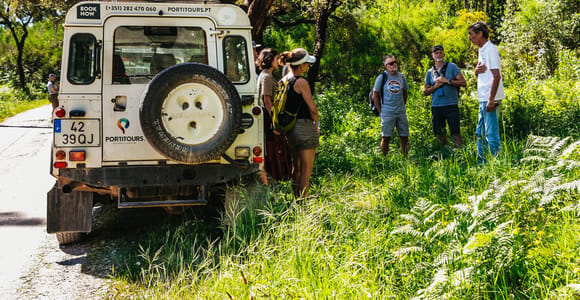
If there is drinking involved. The Algarve jeep safari with a distillery visit and lunch runs 7 hours 30 minutes at €72 and is rated 4.8 from 271 reviews. It passes through old villages, stops at a distillery for the local spirit, and includes lunch at a typical restaurant. Someone who has spent part of the day tasting a potent local spirit is not the person who should then be driving a hire car down a hill road, and this is the clean solution to that.
If you want the tracks rather than the tarmac. The route above is entirely on surfaced roads, and that is deliberate: a rental agreement typically restricts where the car may be driven, and driving outside those terms is one of the situations in which the protection you paid for stops applying. Check your own conditions before you turn onto a dirt track — the section to read is described in excess, deposit and what gets added at the desk. The unsurfaced part of the interior is what the jeep tours are for, and it is the one piece of this landscape a hire car should not take you to.
If wine at a shorter distance is the appeal, the Quinta da Tôr winery near Loulé runs guided tours and tastings at €18, and the rock-salt mine at Loulé sits on the same side of town — both are on the way to Querença and both solve an afternoon.
Is it worth a rental day?
Yes, and it is the clearest yes on this site: two hours twenty by bus with a change, against 35 kilometres of your own road, to four places no tour from this marina goes. If you are hiring for a short stretch of the week rather than all of it, this is the day to put in the middle of it.
What the hire itself costs, and what the counter will ask for, is in excess, deposit and what gets added at the desk; whether you need a car at all is in do you need a rental car in Vilamoura?. Rates and conditions for this area can be compared at Discover Cars. For the other direction — west, to Silves and the Monchique hills — see the Silves and Monchique day trip, and for what lies immediately around the resort, what to see in the Golden Triangle and the full list of things to do around Vilamoura.